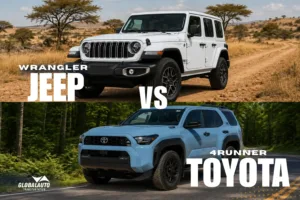
 The Toyota 4Runner and Jeep Wrangler are both built for off-road driving, but they offer very different experiences. In this comparison, we look at the 2026 Toyota 4Runner TRD Off-Road and the 2026 Jeep Wrangler Rubicon 4-Door, both with turbocharged four-cylinder engines, eight-speed automatic transmissions, and four-wheel drive.
So, Toyota 4Runner or Jeep Wrangler? The 4Runner is a better fit for drivers who want off-road capability along with more cargo space, towing ability, and everyday comfort. The Wrangler Rubicon is more focused on difficult trails, customization, and open-air driving.
2026 Toyota 4Runner vs. Jeep Wrangler: Key Differences
The biggest difference between these SUVs is not horsepower. It is what each vehicle is designed to prioritize. The gasoline 4Runner TRD Off-Road uses Toyota’s 2.4-liter turbocharged i-FORCE four-cylinder, producing 278 horsepower and 317 lb-ft of torque. It comes with an eight-speed automatic transmission and part-time four-wheel drive. Toyota also gives this trim Bilstein monotube shocks, 33-inch all-terrain tires, Multi-Terrain Select, and Crawl Control. For 2026, its starting MSRP is $50,690, before destination and optional equipment.
The Wrangler Rubicon can be equipped with Jeep’s 2.0-liter turbocharged four-cylinder, which produces 270 horsepower and 295 lb-ft of torque and pairs with an eight-speed automatic. Rubicon models add the Rock-Trac 4×4 system, serious low-range gearing, locking-differential capability, solid axles, and an electronic front sway-bar disconnect. The four-door Rubicon currently starts at $50,535 before destination and options. That makes the 4Runner vs Wrangler price surprisingly close. Instead of choosing based on MSRP alone, buyers should look at which factory equipment they will actually use.
How Do Their Performance and Fuel Economy Compare?
On paper, the Toyota has the advantage. Its turbo engine delivers eight more horsepower and 22 more lb-ft of torque than Jeep’s turbo four-cylinder.
That extra torque can be useful when merging onto a highway, climbing grades, carrying equipment, or towing. But engine output alone does not determine how either SUV feels. Gearing, tire choice, curb weight, throttle tuning, and four-wheel-drive hardware all influence performance. The 4Runner TRD Off-Road is rated at 19 mpg city and 25 mpg highway, or about 21 mpg combined. Toyota lists those figures specifically for the gasoline TRD Off-Road configuration. The four-door Wrangler with the 2.0-liter turbo and automatic is rated around 20 mpg city, 22 mpg highway, and 21 mpg combined. That makes the 4Runner vs Wrangler fuel economy comparison almost even on combined MPG, although the Toyota has the stronger highway figure.
Real life can look different. Oversized tires, lifts, roof racks, extra cargo, frequent low-range driving, steep terrain, and aggressive acceleration can all push fuel use higher. That matters when comparing them as a 4Runner vs. a Wrangler daily driver. Neither SUV is built primarily for fuel savings, so buyers should look beyond a one- or two-MPG difference and consider how much highway, city, and trail driving they actually do.
Is the 4Runner or Wrangler Better Off-Road?
This is where the Wrangler begins to separate itself. The 4Runner TRD Off-Road is hardly under-equipped. Toyota gives it 33-inch all-terrain tires, Bilstein shocks with remote reservoirs, Multi-Terrain Select, Crawl Control, and trail-oriented four-wheel-drive hardware. These systems are designed to help the vehicle maintain traction and control its speed over loose, uneven, or steep terrain. The Wrangler Rubicon goes deeper into traditional off-road engineering. Its Rock-Trac system provides a 4:1 low-range ratio, while Rubicon models feature an electronic front sway-bar disconnect that lets the front suspension articulate more freely over uneven obstacles. Jeep also offers front and rear Tru-Lok electronic locking differentials. Those features matter when 4Runner vs. Wrangler off-road means rock crawling, deep ruts, steep ledges, or trails where keeping individual tires planted can determine whether the SUV moves forward.
The Wrangler’s relatively compact body, solid axles, low gearing, and articulation make it especially comfortable on technical terrain. It also offers aggressive approach geometry with available off-road packages. The 4Runner takes a slightly broader approach. Its trail systems are highly capable, but its larger enclosed body and utility-oriented layout also make sense for camping, overlanding, forest roads, and long trips that combine hundreds of highway miles with off-road sections. That is why ground clearance alone should never decide the winner. Tires, suspension travel, wheelbase, approach and departure angles, traction systems, gearing, and driver experience all matter. For difficult technical trails, the Wrangler Rubicon has the stronger case. For buyers who want serious capability without making trail performance the vehicle’s entire personality, the 4Runner may be easier to live with.
Which SUV Is Better for Daily Driving and Practicality?
A capable 4×4 still has to handle grocery runs, traffic, school pickups, highway trips, and parking lots. That changes the Jeep Wrangler vs. Toyota 4Runner discussion. The 4Runner uses Toyota’s TNGA-F body-on-frame platform, which Toyota says provides increased rigidity while maintaining the durability expected from a truck-based SUV. It also retains a conventional enclosed body, a rear liftgate, and its signature power-operated rear window.
The Wrangler is intentionally different. Its removable doors and available removable roof systems are central to the ownership experience. Jeep specifically designs the Wrangler around open-air driving in a way the 4Runner does not try to match. That personality comes with tradeoffs. The Wrangler’s solid axles, removable body panels, and trail-focused design make it more specialized. The 4Runner is generally the more conventional SUV of the two, which may appeal more to buyers spending most of their week on pavement.
Comfort, Interior, and Cargo Space
The Toyota 4Runner vs. Jeep Wrangler interior comparison depends heavily on what you value. The Wrangler’s cabin feels purpose-built around adventure. Everything from upright design and removable doors to an available removable roof to exposed functional elements reinforces its off-road character. The 4Runner feels more like a traditional midsize SUV, with a large enclosed cargo area and easier integration into everyday family or travel use.
Toyota also keeps the power rear window, which can make accessing smaller items in the cargo area more convenient. Cargo space is one of the clearest practical differences. Toyota lists up to 90.2 cubic feet with the seats folded, while Jeep’s four-door Wrangler specifications list substantially less total cargo room. That matters if you regularly carry camping equipment, suitcases, tools, sports gear, pet crates, or bulky purchases. In a 4Runner vs. Wrangler cargo space comparison, the 4Runner is easier to recommend for buyers who routinely need enclosed storage. The Wrangler counters with something more emotional than practical: take off the doors, open the roof, and the entire driving experience changes.
Towing Capacity and Safety
Towing is another area where the 4Runner has an advantage. Toyota rates the current 4Runner lineup for up to 6,000 pounds of towing capacity. Jeep states that a properly equipped four-door Wrangler can tow up to 5,000 pounds. That gives Toyota the higher ceiling in the 4Runner vs Wrangler towing capacity comparison. Still, buyers should never assume the advertised maximum applies automatically to every vehicle. Axle configuration, installed equipment, cargo, passengers, and trailer setup can affect the usable towing limit.
For driver assistance, the 4Runner includes Toyota Safety Sense 3.0 across the lineup. The Wrangler offers modern driver-assistance features as well, although availability can depend on trim and equipment. Toyota also offers trail-focused camera technology, while Jeep integrates driver-assistance hardware in a way designed not to interfere with available off-road bumpers and other trail equipment. A simple 4Runner vs. Wrangler safety winner is harder to name because equipment and crash-test availability should be compared by exact model year and configuration rather than by reputation.
Which Offers Better Price and Long-Term Value?
At roughly $50,000 before destination and options, these two SUVs begin surprisingly close together. The important question is what happens after purchase. Fuel, tires, insurance, scheduled maintenance, repairs, accessories, depreciation, and modifications all contribute to the Toyota 4Runner ownership cost or the Jeep Wrangler ownership cost. A stock Wrangler and one with a lift, heavy bumpers, 35-inch tires, and a winch can have very different long-term expenses. Warranty coverage is similar. Toyota provides a 3-year/36,000-mile basic warranty and 5-year/60,000-mile powertrain warranty. Jeep provides the same basic and gasoline powertrain coverage periods.
Toyota also includes ToyotaCare maintenance on new vehicles, which can reduce scheduled maintenance costs during the initial ownership period. That should not be confused with proof that the 4Runner will always cost less to maintain long-term. The Toyota 4Runner vs. Jeep Wrangler reliability question also needs caution. The sixth-generation 4Runner only arrived recently, so the previous model’s long-term reputation cannot automatically be applied to the 2026 version. Likewise, a Wrangler’s ownership experience can vary greatly depending on configuration, use, and modifications.
So instead of trying to declare a universal value winner, consider how each SUV matches the way you will actually use it. Choose the 4Runner TRD Off-Road if you place more value on cargo room, towing, highway usability, and a balance between trail capability and everyday practicality. Choose the Wrangler Rubicon 4-Door if you prioritize technical terrain, low-range capability, suspension articulation, open-air driving, and a huge range of customization possibilities.
Shipping a 4Runner or Wrangler After an Out-of-State Purchase
The exact SUV you want may be hundreds or even thousands of miles away. Buyers often find a particular trim, color, option package, or modified vehicle through an out-of-state dealer or private seller. When arranging SUV shipping, give the transport company the exact trim and tell them about any modifications before getting a quote. Lift kits, oversized tires, roof racks, winches, steel bumpers, and other accessories can change the vehicle’s height, width, weight, and loading requirements.
A stock Wrangler or 4Runner does not automatically require enclosed transportation. Open transport is commonly suitable for standard SUVs, while enclosed shipping provides additional protection from open-road exposure. You can compare the two options in this guide to open vs. enclosed car shipping. Accurate vehicle details are particularly important for modified vehicle shipping, because even a relatively simple lift and tire upgrade can affect carrier clearance.
Which SUV Is the Better Choice for You?
So, which is better: the Toyota 4Runner or the Jeep Wrangler? For most buyers looking for one SUV to handle commuting, road trips, cargo, towing, and serious weekend trails, the 4Runner TRD Off-Road is the more practical all-around choice. Its stronger torque figure, higher maximum towing rating, larger cargo area, and conventional SUV layout give it an edge once the trip moves away from the trail.
The Wrangler Rubicon 4-Door is the more specialized off-roader. Rock-Trac low-range gearing, locking differentials, a disconnecting front sway bar, solid axles, and removable doors and roof panels give it a character and level of technical trail focus the 4Runner does not completely replicate. The real winner in the 4Runner vs. Wrangler comparison depends on where you spend your time. If the hardest part of your week is a long commute followed by a weekend trail, the 4Runner makes a compelling case. If difficult terrain is the destination and pavement is simply how you get there, the Wrangler Rubicon is hard to ignore.